Schiit Audio Mimir DAC Review

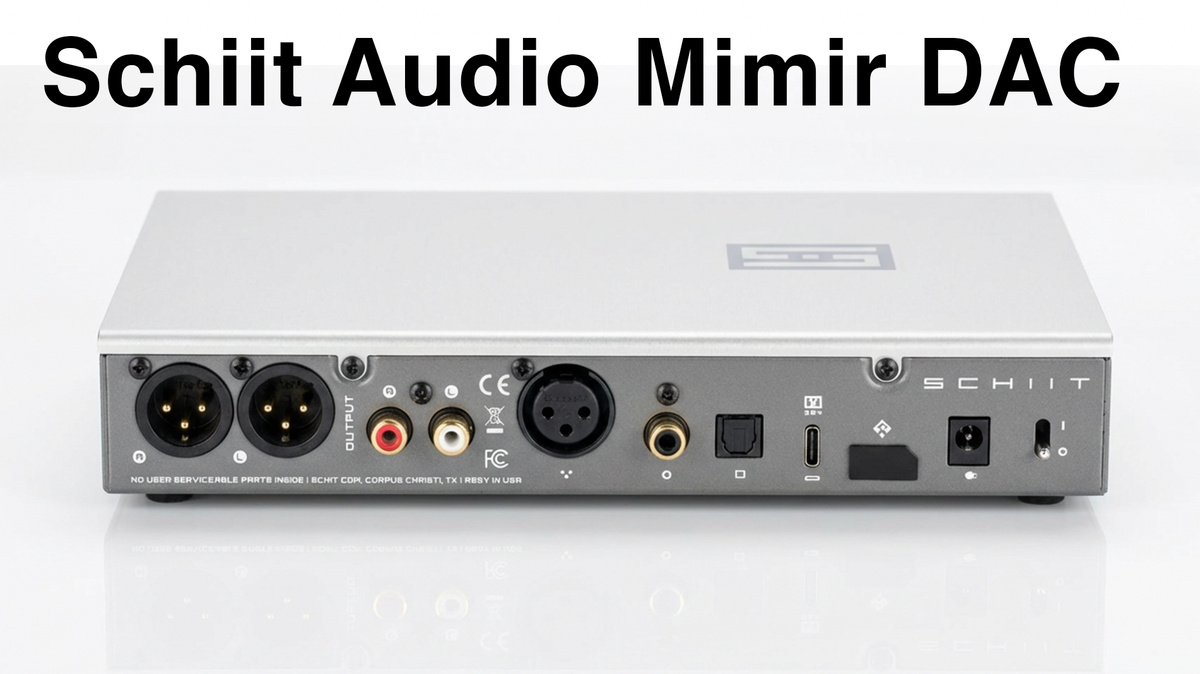
A budget to mid range DAC that brings Schiit Audio's legendary proprietary digital filter to the masses at an unprecedented price point.
If you have ever looked at Schiit's higher-end multibit DACs and thought: this is the sound I want, but I don't need to spend Yggdrasil money, the Schiit Audio Mimir is exactly the kind of product that changes your shortlist.
Visit the Schitt official amazon store here.
It is a compact, desktop-friendly DAC that combines three important things:
- Schiit's proprietary "Megacomboburrito" digital filter — previously only available in their flagship products — now implemented affordably through their Mesh™ design architecture.
- Linear Override power supply — run off USB for convenience or plug in the wall adapter for true linear power with higher voltage rails.
- Full digital preamp functionality with 3-band parametric EQ via the additional Forkbeard™ module.
- Both balanced XLR and single-ended RCA outputs in a sub-£350 package.
The headline story here is Mesh. For the first time, Schiit has found a way to bring the distinctive digital filter that defines their house sound down from expensive Analog Devices DSP chips to an affordable 32-bit Microchip processor paired with a standard ESS ES9028 delta-sigma modulator.
This is not just another ESS implementation with off-the-shelf filtering. This is Schiit's signature sound, developed and refined over decades by Mike Moffat, now accessible at budget/mid tier DAC pricing.
This review breaks down what the Mimir is, how it is built, how it sounds, what owners are saying, how it compares to popular alternatives, and who it makes the most sense for.
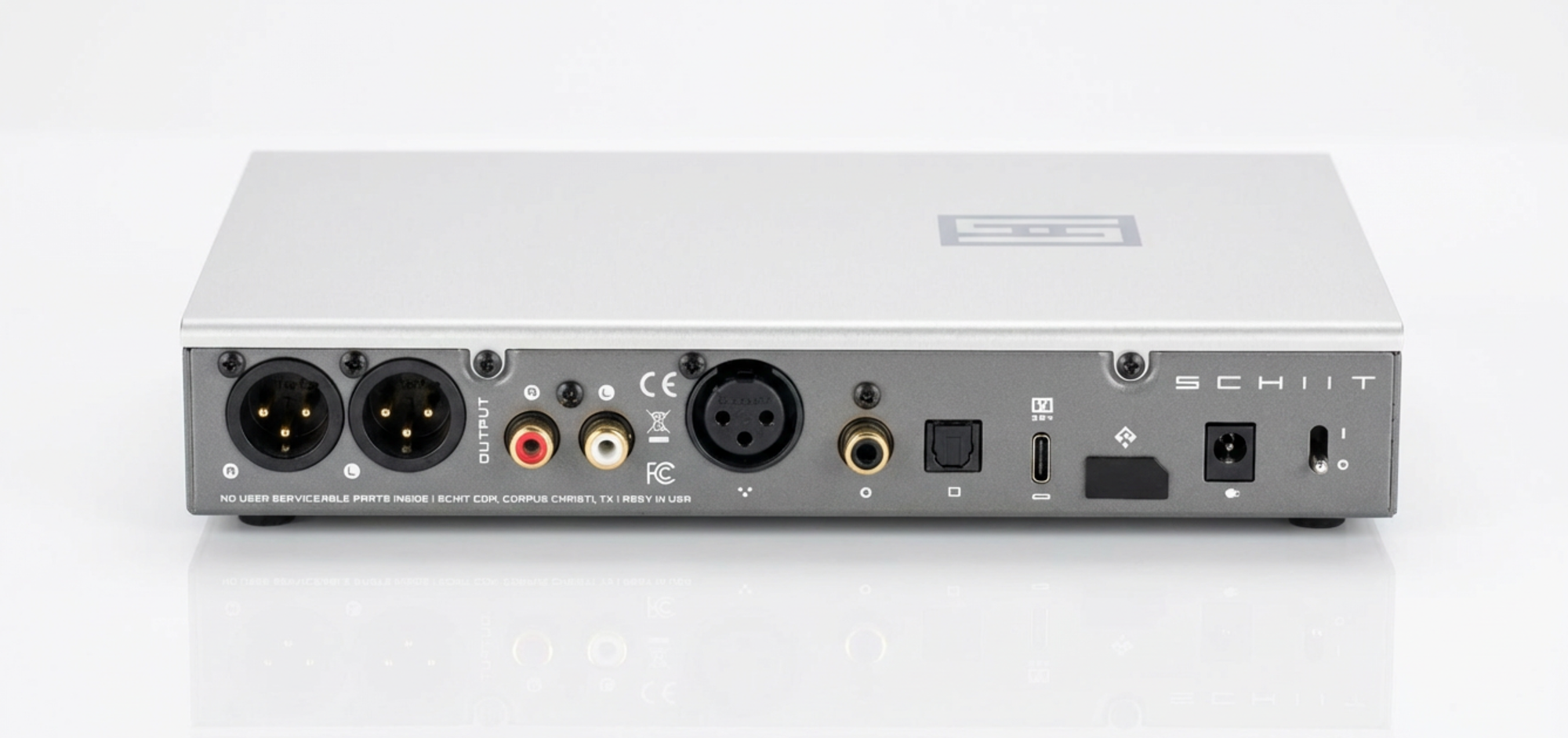
Quick take
The Mimir is for you if you want Schiit's legendary proprietary digital filter at an unprecedented price point, need both balanced and single-ended outputs, or want the flexibility of digital preamp functionality with EQ.
It is not for you if you need network streaming capability, want DSD or MQA support, or you are looking for the absolute cleanest measurements at any cost.
What the Mimir actually is
The Mimir is a desktop DAC, with optional digital preamp functionality. In plain English: it takes a digital signal from your computer, streamer, or CD transport, converts it to analog with Schiit's proprietary filtering, and feeds your amplifier, headphone amp, or active speakers.
But this is not just another ESS implementation. The conversion stage and digital filtering are where Schiit has done something genuinely revolutionary at this price point.
For years, Schiit's house sound has been defined by what Mike Moffat calls the "Megacomboburrito" digital filter. This proprietary filter, developed over decades, has traditionally required expensive Analog Devices DSP chips and has only been available in Schiit's higher-end products like the Bifrost 2, Gungnir 2, and Yggdrasil.
The Mimir changes everything. Through their Mesh architecture, Schiit has found a way to implement a scaled version of this legendary filter using a 32-bit Microchip processor paired with a standard ESS ES9028 delta-sigma modulator. This makes the distinctive Schiit sound accessible at a price point that was simply impossible before.
DAC design and architecture
Mesh: Schiit's proprietary filter brought to the masses
The headline feature of the Mimir is what Schiit calls Mesh. This represents a genuine breakthrough in making high-end digital filtering accessible at budget pricing.
To understand why this matters, you need to know about Schiit's approach to DAC design. While most manufacturers simply use the built-in digital filters that come with DAC chips from ESS, AKM, or other vendors, Schiit has spent decades developing their own proprietary filter. Mike Moffat, Schiit's co-founder and the legendary designer behind products like the Theta Digital Generation V, calls this the "Megacomboburrito" filter.
This filter is the secret sauce behind the distinctive Schiit sound. It is carefully optimized in both the time and frequency domains to deliver what Schiit believes is more natural, more musical sound than off-the-shelf implementations. The problem is that running this complex filter has traditionally required expensive Analog Devices SHARC DSP chips, which is why it has only appeared in Schiit's higher-end products.
The Mimir solves this through Mesh. By using a more affordable 32-bit Microchip processor and pairing it with a standard ESS ES9028 delta-sigma modulator, Schiit has found a way to implement a scaled version of their proprietary filter at a fraction of the traditional cost.
This is not a compromise. The Mesh filter delivers the core characteristics of Schiit's house sound — smooth, organic, musical — in a package that costs £300 instead of £700 or more.
Why people care: Digital filters fundamentally shape how a DAC sounds. They determine time-domain behaviour, frequency response, and the overall character of the presentation. Most budget DACs use generic filters because custom implementations are expensive. The Mimir gives you Schiit's proprietary filtering — the same fundamental approach used in their flagship products — at entry-level pricing. This is genuinely unprecedented.
The result is a DAC that avoids the typical ESS "glare" or "brightness" that some listeners find fatiguing, while maintaining excellent resolution and detail. You get smooth, natural tonality without sacrificing transparency.
Analog stage design
The analog output stage uses high-quality op-amps: LME49724 for balanced output and OPA1656 for single-ended. Both outputs are independent, DC-coupled, and use precision thin-film resistors and film capacitors.
Both outputs can be active simultaneously, which is handy if you want to run XLR to an amp and RCA to a subwoofer or recording device.
Power supply flexibility
The Mimir features what Schiit calls Linear Override — a unique dual-mode power supply system that gives you the best of both worlds.
In USB-only mode, the Mimir runs entirely off USB power using a charge pump rail generator to provide +/-5V rails. It reports as a 500mA USB device. This is perfect for desktop setups where simplicity and minimal cable clutter matter. Maximum output is 3.0V RMS balanced and 1.5V RMS single-ended, which is more than adequate for most headphone and line-level applications.
But here is where Linear Override becomes genuinely clever: plug in the included 14-16VAC wall adapter and the Mimir automatically switches to a true linear power supply with +/-12V rails. The DAC then reports as 0mA to your USB host, taking no power from the computer at all.
This is not just about higher voltage rails. Linear power supplies are preferred by audiophiles because they provide cleaner, more stable power with lower noise compared to switching supplies or USB power. The result is higher maximum output voltage — 4.0V RMS balanced and 2.0V RMS single-ended — plus potentially better sonic performance, especially with demanding headphones or longer cable runs.
Why this matters: Most budget DACs either run entirely off USB power (limiting output voltage and potentially introducing noise from the computer) or require an external power supply (adding cost and complexity). Schiit's Linear Override gives you both options. Use USB-only for simplicity and portability, or add the wall adapter when you want maximum performance. The flexibility is genuine and practical, not just a marketing feature.
For desktop headphone use, many owners report excellent results running entirely off USB power. For driving demanding planars, running balanced to power amplifiers, or simply chasing the best possible performance, Linear Override delivers meaningfully higher output and cleaner power.
Formats and connectivity
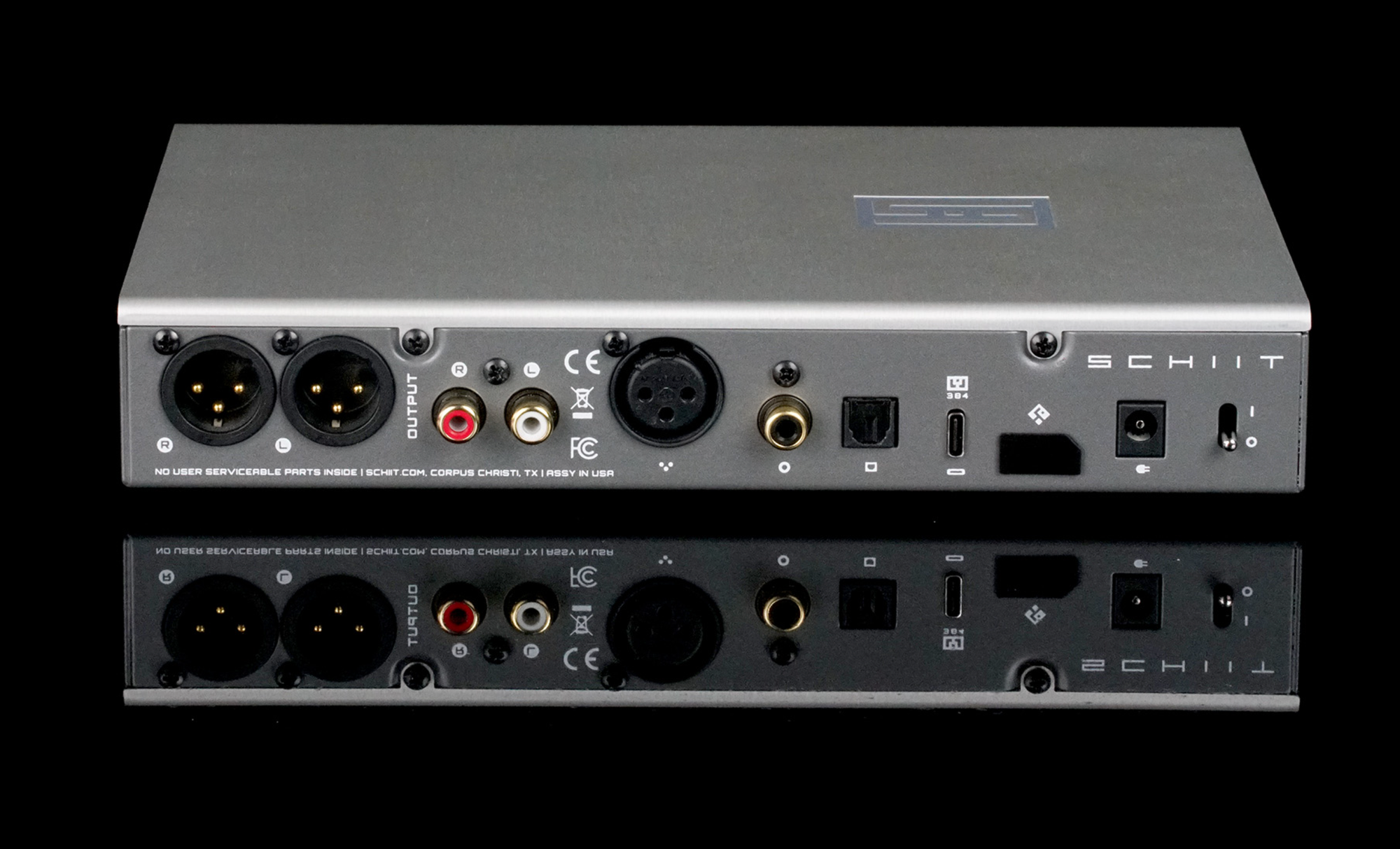
The Mimir supports a solid range of high-resolution PCM formats, though it deliberately skips DSD and MQA.
Format support
- PCM up to 32-bit/384kHz via USB
- PCM up to 24-bit/192kHz via optical, coaxial, and AES/EBU inputs
- No DSD support
- No MQA support
Notably Schiit has been clear about this: they believe PCM is the superior format and see no reason to support what they consider unnecessary additions.
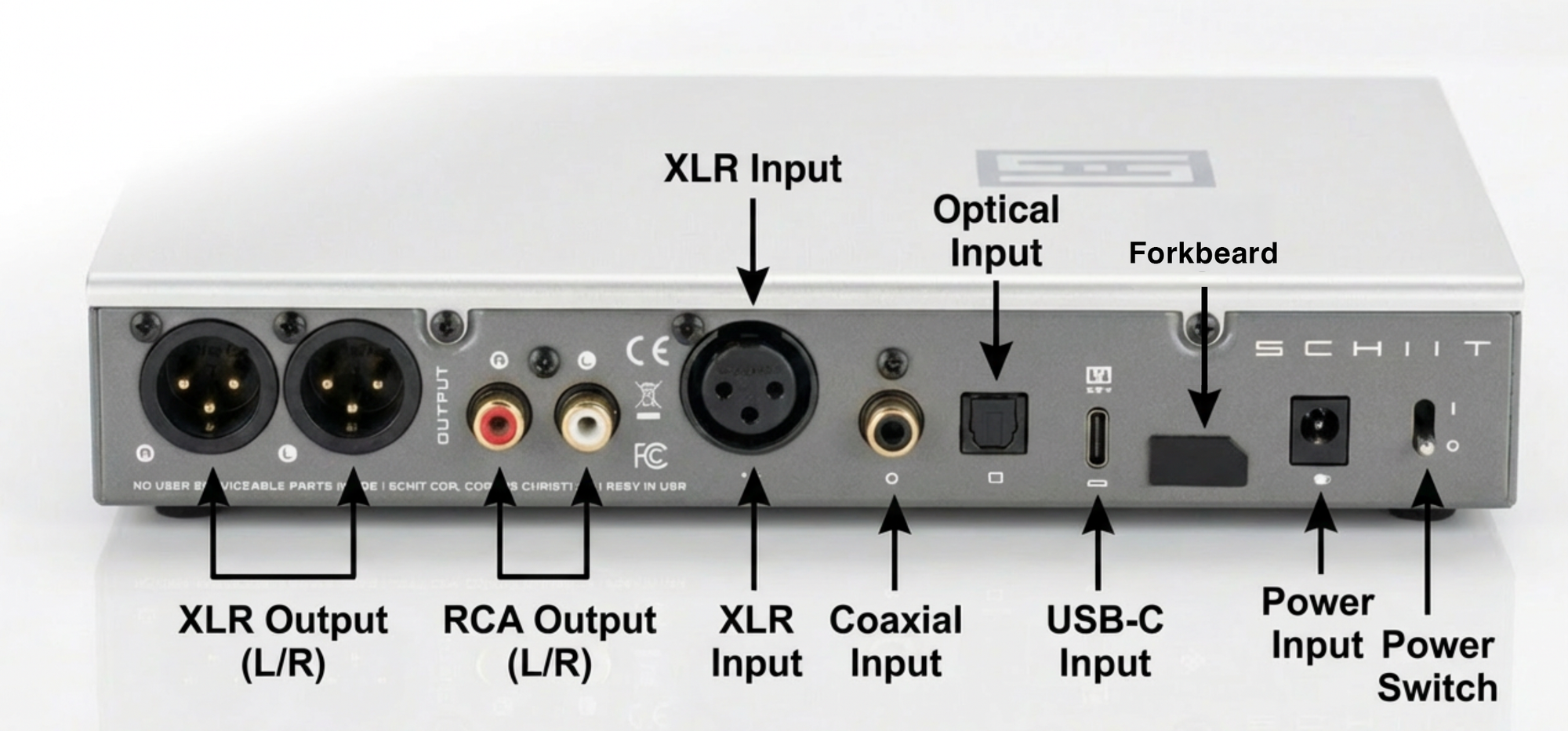
Inputs
- USB-C with Unison 384™ (UAC2 compliant)
- Optical SPDIF (TOSLINK)
- Coaxial SPDIF (RCA)
- AES/EBU (XLR)
The Unison 384™ USB implementation is Schiit's custom design and has a strong reputation for working reliably across different sources without driver hassles.
Outputs
- Balanced XLR (line level)
- Single-ended RCA (line level)
Having balanced outputs at this price point is unusual and genuinely useful if you are running balanced gear. The DAC also includes a rear mounted, vintage style power off/on switch.
Forkbeard Expansion Options — See Schiit Audio's Forkbeard page for more on this, alongside this video.
Build, UI, and daily use
Physical design
The Mimir is compact, all-aluminum, and follows Schiit's typical minimalist aesthetic. It fits easily on a desk without taking up much space. Available in black or silver.
The front panel has a simple LED display showing input and sample rate, along with basic controls. The overall feel is solid and well-built, though some owners note the panel LEDs are slightly dimmer than on other Schiit units.
Setup and compatibility
Plug-and-play with Mac and Windows via USB. The Unison 384 USB implementation is UAC2 compliant and works without drivers on modern operating systems.
The Linear Override power system means you can start simple with just USB power and add the included wall adapter later when you want maximum output voltage and the benefits of linear power. Many users run entirely off USB for desktop headphone use and report excellent results, while others prefer the higher voltage rails and cleaner power delivery that Linear Override provides.
Firmware updates
If you have Forkbeard, the Mimir is updatable over the air via the Schiit Forkbeard app. No need to send the unit in for upgrades if Schiit adds new capabilities.
How it sounds
This is where the Mimir gets interesting, because it is not chasing measurement supremacy. It is chasing musicality.
Tonality
The overall character is best described as slightly warm and organic, especially compared to other budget delta-sigma DACs.
This is the Mesh filter doing its job. While typical ESS implementations can sound bright, analytical, or even harsh in the treble, the Mimir's proprietary filtering delivers a smoother, more natural presentation that retains detail without fatigue.
- Not thick or overly coloured.
- Not analytical or sterile.
- Smoother and more natural than many ESS-based competitors.
- Avoids the typical ESS "glare" or "brightness" that some listeners find fatiguing.
This is Schiit's house sound at an accessible price. Vocals tend to have body and texture. Acoustic instruments feel less "digital" and more present. The presentation leans engaging without blunting detail.
The difference between the Mimir and a budget DAC using stock ESS filtering is not subtle. The proprietary filter fundamentally changes the character of the presentation, making it more musical and less fatiguing for extended listening sessions.
Soundstage and imaging
One of the most consistent themes in user feedback is improved soundstage and imaging compared to entry-level DACs.
Owners frequently describe the Mimir as presenting:
- Greater width and depth than expected at this price
- Better instrument separation and layering
- Clearer centre imaging, especially for vocals
- Less congestion in busy musical passages
Compared to the Modi 5, which many owners upgraded from, the difference is described as significant and immediately noticeable.
Resolution and detail
The Mimir reveals layers in well-recorded material that cheaper DACs tend to gloss over. Listeners report hearing texture in guitar strings, subtle nuances in vocal delivery, and better separation of overlapping instruments.
One owner using it with Beyerdynamic DT 1990 headphones described being able to hear the texture of guitar picks plucking strings and multiple complex instruments remaining clear and distinct.
Bass performance:
Bass is controlled and well-defined, with good weight and impact. Some listeners note the bass takes a few hours of use to fully flesh out, after which the presentation becomes more even-handed.
Compared to built-in DACs in streamers or entry-level units, the Mimir delivers noticeably better bass control and extension.
Treble and high frequencies
This is where the Mesh filter shows its character. The treble is smooth and refined without being rolled off. Cymbals are natural, though one listener noted they are slightly softer compared to Schiit's flagship Gungnir Multibit.
For those sensitive to treble harshness, the Mimir is a relief. It avoids the typical ESS sharpness while maintaining good air and extension.
Mesh vs NOS filter modes
If you have the additional Forkbeard module (additional cost), you can switch between Mesh and NOS modes on the fly.
Mesh mode delivers the Schiit house sound: smooth, organic, and musical. NOS mode is more laid-back and can reduce any perceived upper-frequency energy, though it also changes the overall presentation significantly.
Most owners settle on Mesh mode as their preference, but having the option is valuable for experimentation.
Comparisons to Schiit Audio Modi 5
Multiple owners have compared the Mimir directly to the Modi 5, which it replaces in Schiit's lineup.
The consensus is clear: the Mimir is a significant upgrade. The Modi 5 is pleasant but somewhat rounded and softened, with limited soundstage depth. The Mimir presents greater transparency, better soundstage, and more detail, and the difference is not subtle.
Real-world user impressions
Across forum discussions, written reviews, and video content, the themes are remarkably consistent.
Written reviews and owner feedback
On Head-Fi, reviewer adydula gave the Mimir a 5-star rating and praised its implementation of the Mesh filter as bringing Schiit's signature sound to an affordable price point. He noted excellent connectivity options, small form factor, and the flexibility of optional Forkbeard functionality. After extensive testing comparing the external Mimir to the internal Mesh adapter in the Asgard X, he found no discernible sonic differences between them.
Multiple owners report spending more time listening to music and less time thinking about gear. One user on AVS Forum described their experience with the Mimir as "revolutionary," stating they could hear texture in guitar strings as the pick plucked them.
Another owner on AudioKarma, after comparing the Mimir to high-end DACs like the Denafrips Pontus and Chord Dave, stated: "The Mimir is simply incredible... everything sounds so natural".
Common themes in owner reports include:
- "Imaging and soundstage are impressively good for the money".
- "Midrange is more organic and natural than typical ESS implementations".
- "The Mesh filter really does make a difference".
- "Completely silent over USB, even without an isolator".
Video reviews:
Passion for Sound (Lachlan):
Stop buying expensive DACs and just get this! Australian reviewer Lachlan provided one of the most thorough reviews, stating he preferred the Mimir to the more expensive Bifrost 2/64 because it delivered better articulation without being "etched".
WaveTheory:
Schiit Mimir DAC + Forkbeard Review - Has Schiit Changed the Game Again?WaveTheory called the Mimir a "game changer," focusing on the effectiveness of the Mesh filter implementation.
Digital Sound Babe Review
Schiit Mimir DAC First Listen!Digital Sound Babe provided early perspective on the Mimir's performance and value proposition in the competitive budget market.
Comparisons: where the Mimir fits
Here is the simplest way to think about it.
Mimir vs FiiO Warmer R2R
The FiiO Warmer R2R (£349) features tubes and mechanical VU meters. The Warmer delivers a distinctly warm, organic sound, but it is a dedicated DAC with no preamp features. The Mimir is more versatile with its Forkbeard preamp options and offers a slightly more neutral and transparent presentation with better soundstage precision.
Mimir vs Gustard Audalytic DR70
The Gustard DR70 (£399) is a discrete R2R DAC with built-in network streaming. It is the better choice if you want a single-box streaming solution and DSD support. The Mimir is better if you already have streaming covered and want digital preamp functionality with EQ and filter options.
Mimir vs Topping D70 or similar
Topping-style DACs chase ultra-low distortion and often measure better on paper. If you want a studio-reference DAC, these are excellent. If you want a warmer, more musical presentation, the Mimir is the clear alternative.
Mimir vs Schiit Modi Multibit
The Modi Multibit has the classic "multibit" sound but lacks the resolution and modern features of the Mimir. The Mimir is the more versatile product.
Mimir vs Cambridge Audio DacMagic 200M
The DacMagic 200M is a safe, neutral-to-warm choice with MQA support. However, it lacks the Mesh filter and balanced outputs. Notably, the Schiit Mimir is designed and built in the USA, whereas the Cambridge unit is made in China.
Who should buy the Mimir
It is a great fit if you want:
- A budget DAC with balanced outputs and Schiit's signature sound
- Digital preamp functionality with remote control and EQ
- A single-box solution for a desktop headphone setup
- An upgrade from entry-level DACs or built-in streamers
- A warm, musical presentation without sacrificing detail
It is not ideal if you need DSD or MQA support, network streaming, or the most analytically neutral measurements possible.
The Mimir is available through the official UK distributor which stocks Schiit products locally.
Suggested system pairings
Desktop headphone setup
Mimir into a clean headphone amp like Schiit's Midgard or Magnius. Great for long sessions where smoothness matters.
Compact speaker system
Mimir feeding an integrated amplifier or directly into active speakers. Adding Forkbeard can eliminate the need for a separate preamp entirely.
Budget audiophile stack
Pair the Mimir with a Schiit Gjallarhorn F power amp for a complete Forkbeard-controlled system for under £700 total.
Upgrade path for streamer users
If you are using a Bluesound Node or WiiM, the Mimir is a clear and cost-effective upgrade for the built-in DAC.
Final verdict
The Schiit Audio Mimir delivers on its promises while punching well above its price class. The real story is the Mesh concept and the Linear Override power supply.
Schiit has brought their flagship proprietary digital filter down to an unprecedented price point. This is not marketing hype; these are technical achievements that make the Schiit house sound accessible to everyone.
You get proprietary Mesh filtering, balanced outputs, and optional digital preamp features for £299 to £349. If your goal is an affordable DAC that delivers the Schiit sound — smooth, organic, and fatigue-free — the Mimir is a brilliant choice.