Topping E50 II DAC Review

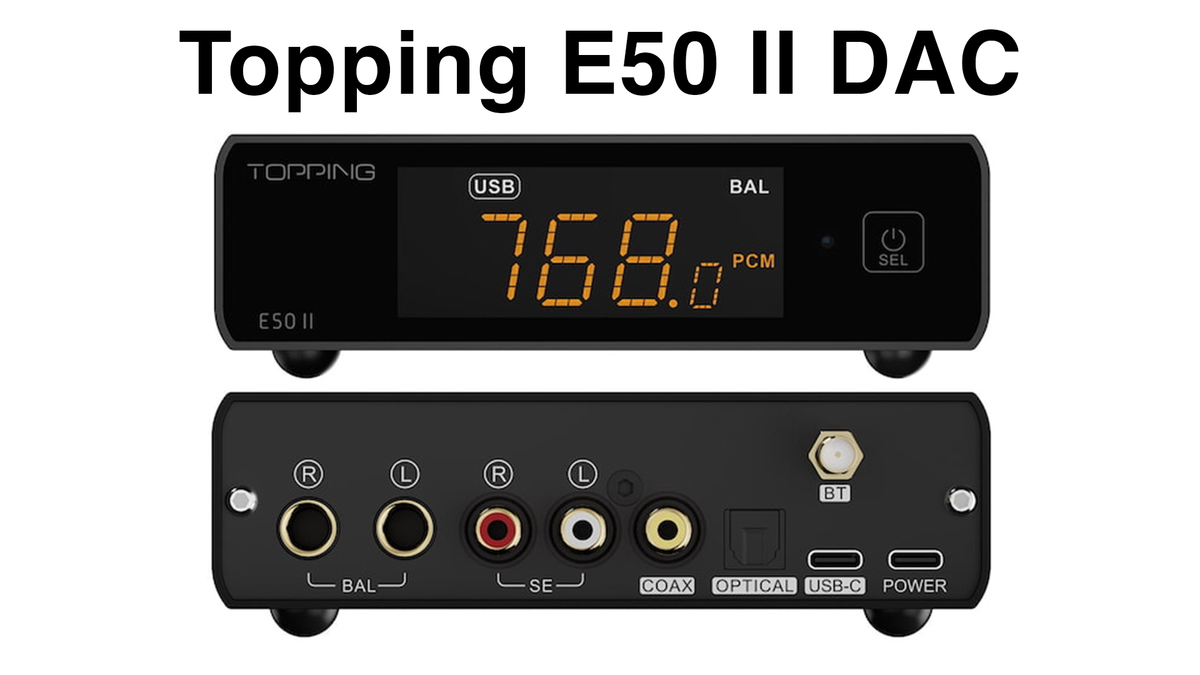
The Topping E50 II is a compact desktop DAC that brings flagship-level technical performance to the mid-budget segment. In plain English: this takes a digital signal from your computer, streamer, TV, or CD player and converts it to analog with exceptional measured performance, feeding your amplifier, headphone amp, or active speakers.
This review breaks down what the Topping E50 II DAC is, how it is built, how it sounds, what owners are saying, and who it makes the most sense for.
 From the Author
The E50 II is for you if you want state-of-the-art measured performance at a very accessible price point, need both balanced and single ended outputs, need a remote control, want Bluetooth connectivity alongside traditional digital inputs, could benefit from advanced features like PEQ, and may need to connect to professional audio equipment.It is not for you if you need a built-in headphone amplifier, want a luxurious looking front panel, or you are looking for R-2R ladder architecture instead of delta-sigma (oversampling) conversion technology.
What Is The Topping E50 II?
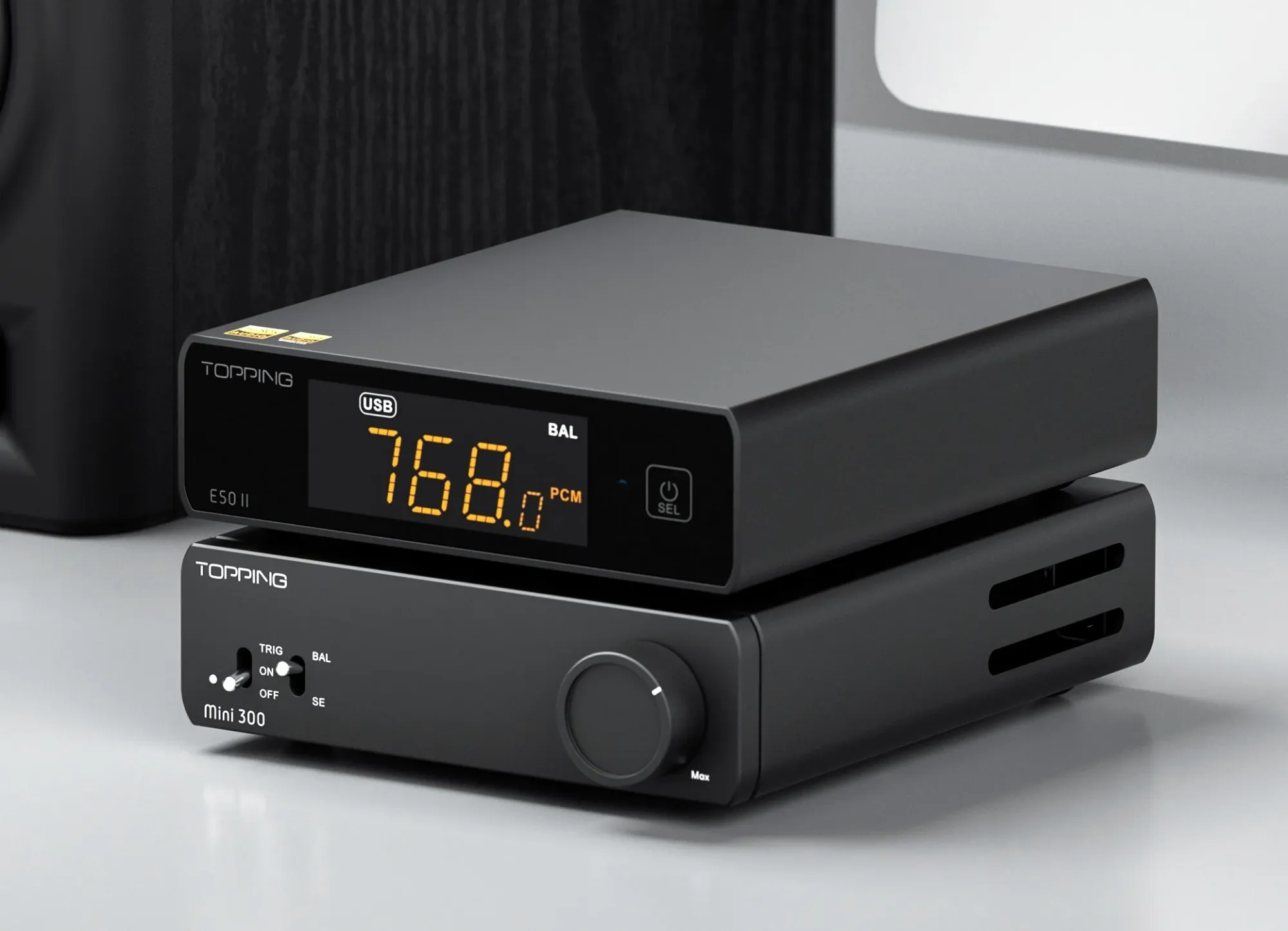
The E50 II DAC is a newly updated version of one of Topping’s most popular desktop DACs. The implementation is straightforward but refined, using a very new AK4497S DAC chip, from AKM's VELVET SOUND family, designed for low distortion and high linearity.This is not exotic multibit or R-2R territory — this is delta-sigma conversion executed to exceptionally high standards, and does represent a big improvement over the ESS Sabre ES9068AS chip used in the first E50 DAC.The output stage is designed for real-world flexibility with selectable voltage levels. RCA outputs can be set to 2.6Vrms or 5.6Vrms, while balanced TRS outputs reach 5.3Vrms or 11.3Vrms (23.2 dBu). The output impedance is low—noise floors goes down to 1.7µVrms on RCA—which matters when driving long cables, demanding preamp inputs, or high-sensitivity amplifiers without adding hum or hiss. The result is a DAC that measures extraordinarily well while maintaining excellent real-world compatibility.
New features in the E50 II include:
- ADAT intelligent detection engine for professional audio integration
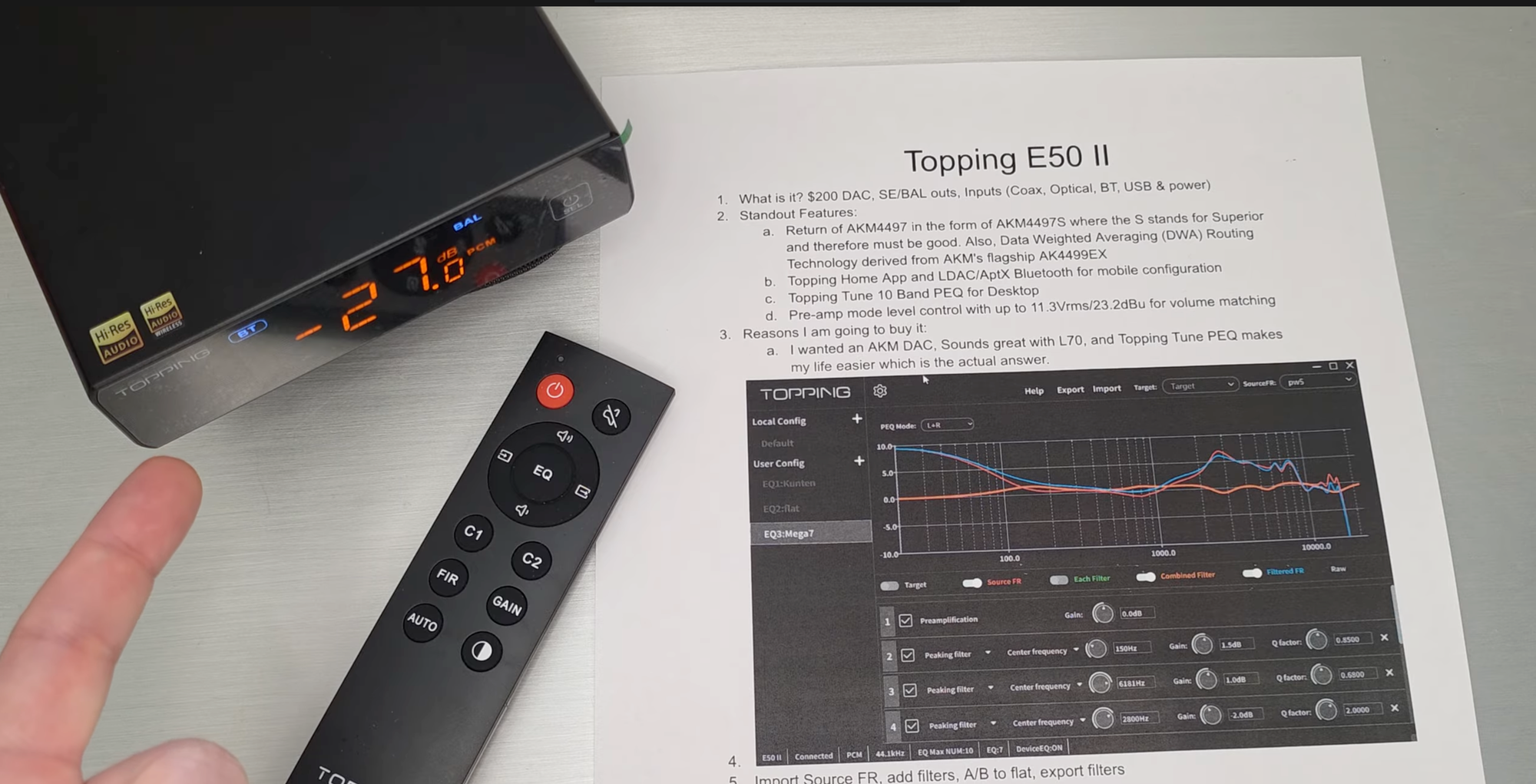
- Built-in PEQ (parametric equalizer) for room correction and tonal adjustments
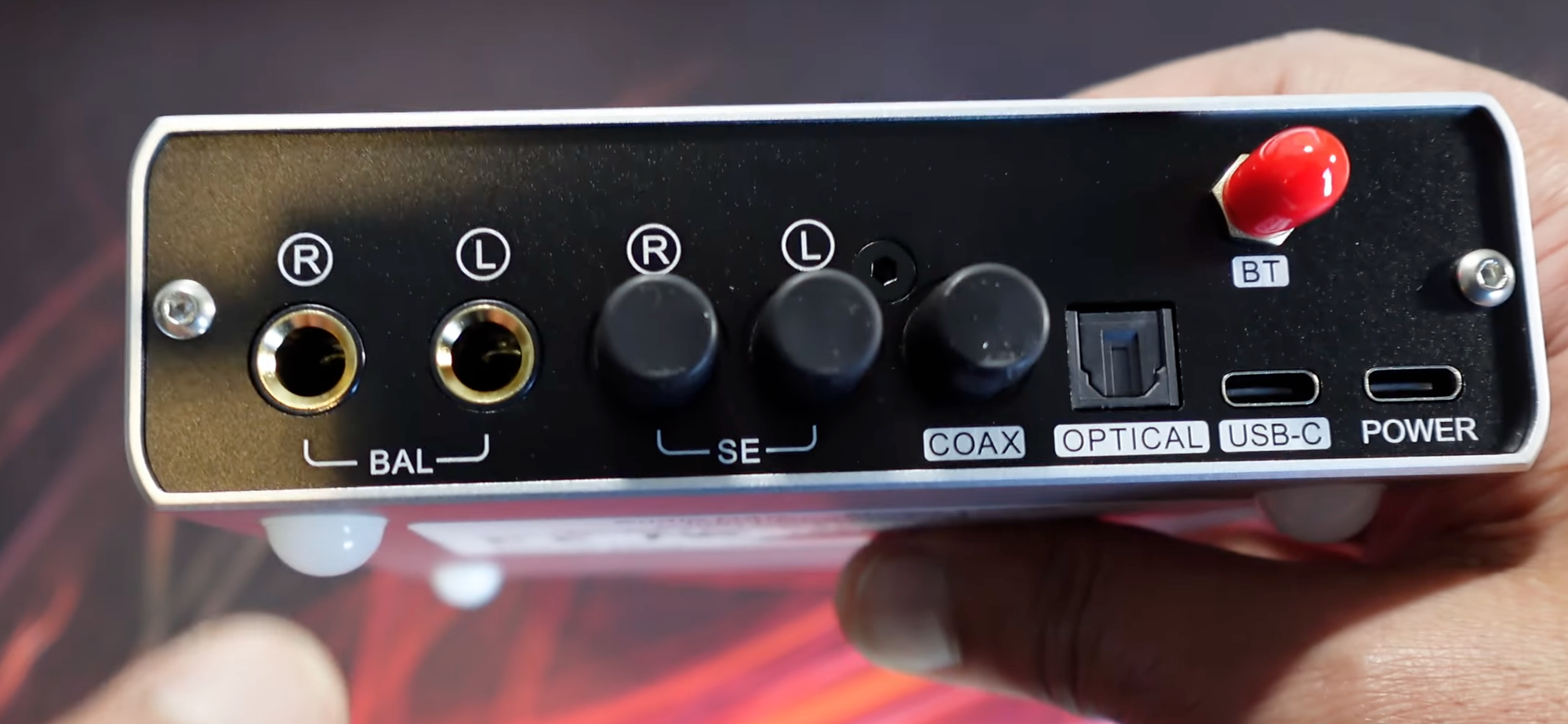
- TRS balanced outputs alongside traditional single ended outputs, which can be used simultaneously if desired
- Topping’s “Topsync Circuit Design”, designed to suppress jitter on the optical and coaxial inputs, helping Topping achieve very low jitter measurements
- Most popular Bluetooth codecs supported including LDAC
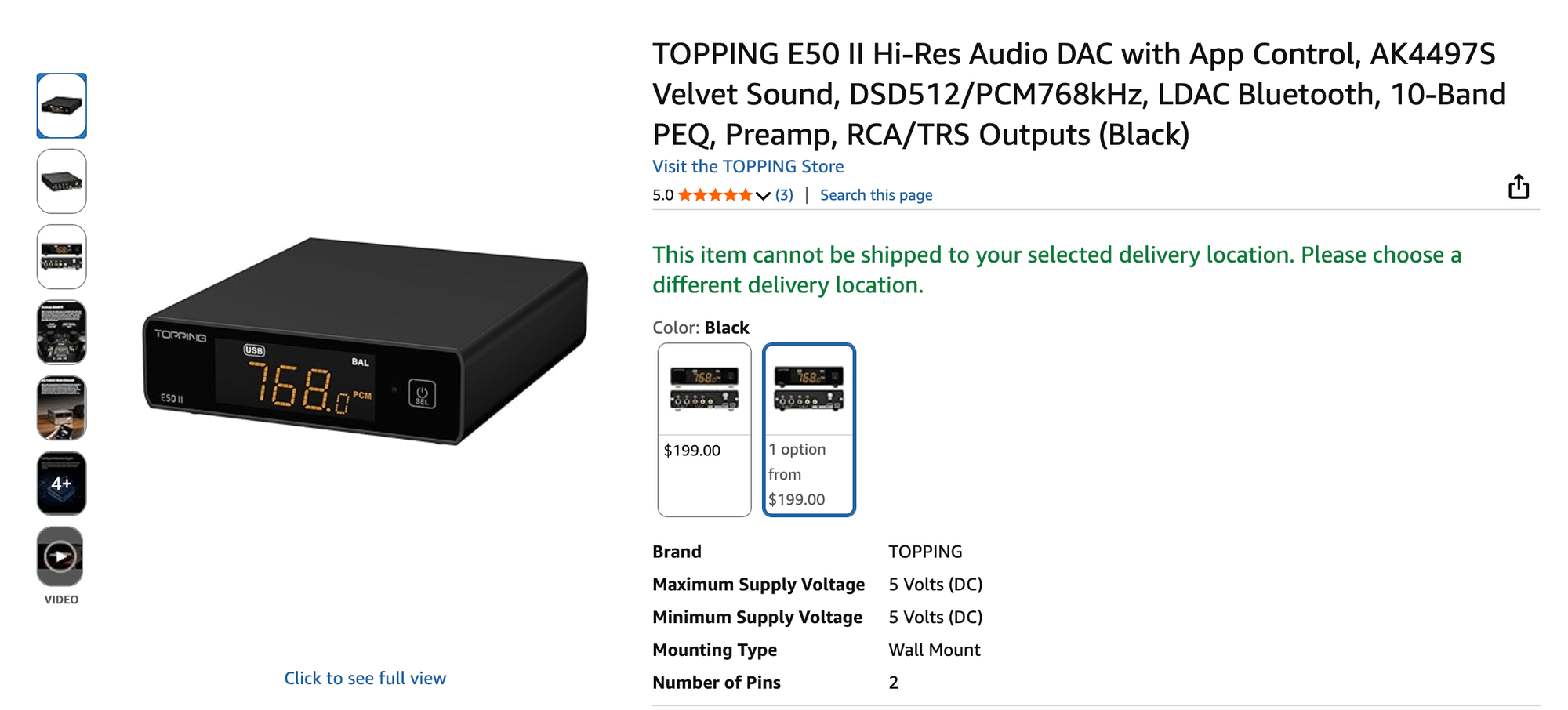
Why people care: Technical performance at this level used to require spending £500 or more. The E50 II delivers SINAD (signal-to-noise and distortion) figures that rival products costing three times as much. This is measurably transparent performance — below the threshold of audibility — in a package that costs just £199/$199.
Build Quality and Design
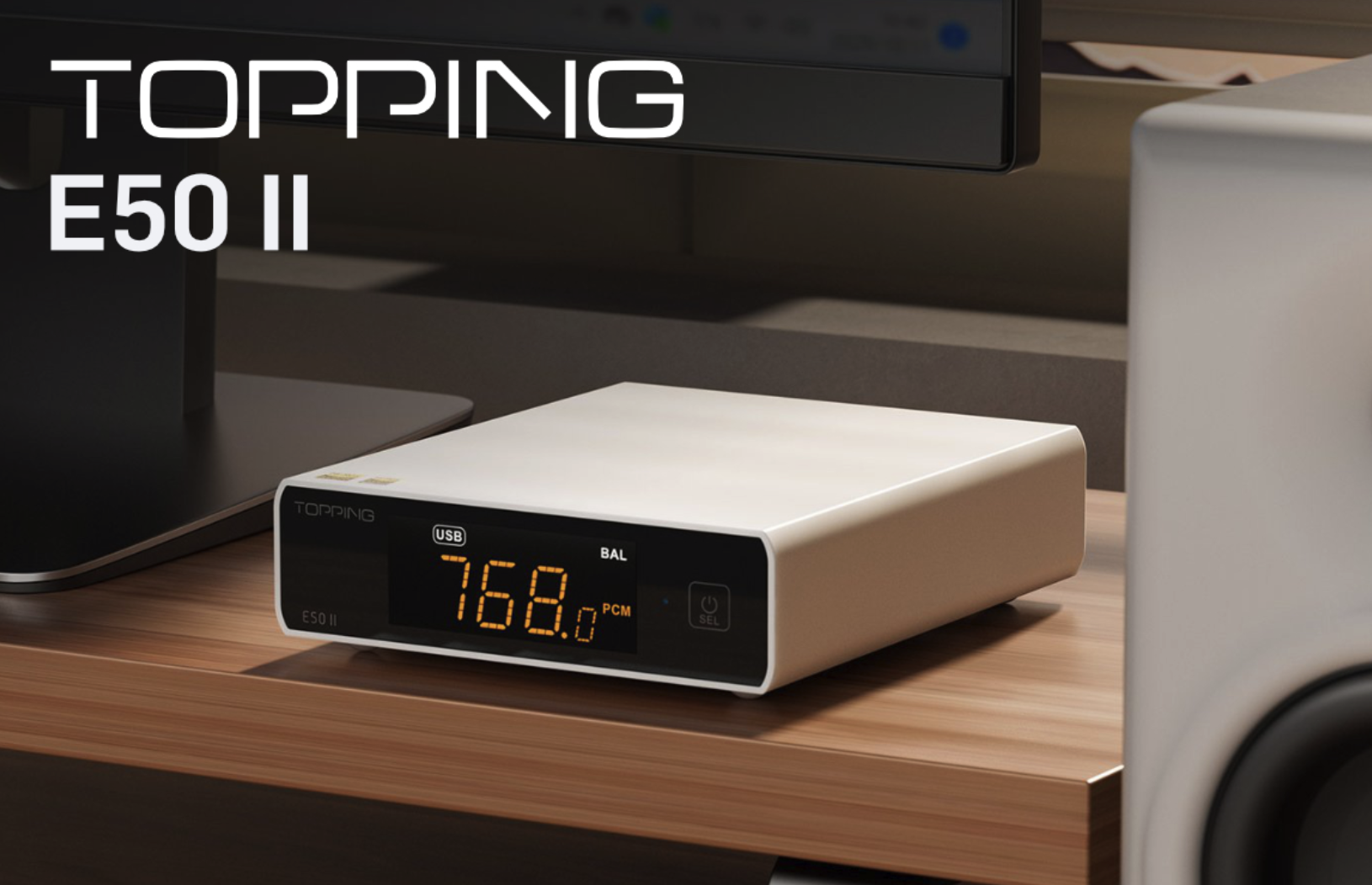
The E50 II follows Topping's established industrial aesthetic: all-aluminum chassis, clean lines, minimal ornamentation. The front panel features a small OLED display with three adjustable brightness levels showing input selection and sample rate, along with touch-sensitive controls that support tap, long press, and double-tap gestures for input switching and other functions. The overall feel is solid and well-constructed, though some owners note the chassis can resonate slightly if not properly dampened.
Available in black or silver, the unit measures 160 x 40 x 200mm and weighs approximately 1kg. It fits easily on a desk without commanding excessive space. The build quality is simple & professional rather than luxurious — this is a tool that prioritizes function over form.
The rear panel provides comprehensive connectivity: USB Type-C (for data), coaxial, optical with SPDIF and ADAT input capability, and Bluetooth 5.0 (antenna). The optical input features intelligent detection that automatically recognizes S/PDIF or ADAT signals. Outputs include both balanced TRS jacks, and single-ended RCAs, allowing flexible system integration. The USB implementation uses the XMOS XU316 platform and supports up to 32-bit/768kHz PCM and native DSD512, which is more resolution than any streaming service or digital file format currently requires, but future-proofs the unit. Power is supplied via USB-C (separate from the audio data USB-C input).
Power Supply and Performance
The E50 II uses 5V USB-C for power delivery. Topping has implemented extensive filtering and regulation internally. The power delivery is clean and stable, with excellent PSRR (power supply rejection ratio) ensuring that mains noise does not reach the audio stages.
The measured performance is exceptional: THD+N of 0.0001% at 1kHz, signal-to-noise ratio up to 131dB, and jitter readings down to approximately -160dB in common measurements thanks to the FPGA+PLL TopSync circuit with JitterNull processing, particularly improving the SPDIF inputs.
Connectivity and Setup
Plug-and-play with Mac, Windows, and Linux via USB. The XMOS XU316 USB platform is UAC2 compliant and works driverless on macOS and modern Linux systems, with a Thesycon driver available for Windows to ensure bit-accurate transfer. Sample rate switching is automatic, and the OLED display confirms the incoming format.
The ADAT input with intelligent detection makes the E50 II particularly appealing for home studio users or those with professional audio interfaces. The intelligent detection automatically recognizes whether the optical input is receiving S/PDIF or ADAT signals (supporting ADAT at 44.1 kHz–192 kHz), making integration seamless.
The built-in parametric EQ can be configured via the TOPPING Tune software or TOPPING Home app, allowing users to implement room correction curves or adjust tonal balance without external DSP. Each of the ten bands offers control of frequency, gain, and bandwidth, with independent left and right channel adjustment. Users can load target curves or corrective filters directly. This is a significant value-add for those who want system optimization without purchasing separate equipment. The PEQ operates on PCM content up to 192kHz/32-bit.
The E50 II also features a bypassable preamp mode, with remote control, allowing you to adjust volume directly and connect to power amplifiers or active monitors without a separate preamp. The user can choose between DAC only and Preamp+DAC modes.
The Bluetooth implementation uses Qualcomm's QCC5125 chip with support for LDAC, aptX Adaptive, aptX HD, aptX, AAC, and SBC codecs, reaching up to 96kHz/24-bit. This provides wireless connectivity for mobile devices while maintaining reasonable audio quality. Bluetooth will never match wired digital inputs for transparency, but the implementation here is competent and convenient.
Many users run the E50 II entirely via USB from their desktop computers and report excellent results. The coaxial and optical inputs provide compatibility with CD transports, streamers, and other digital sources that lack USB output.
Sound Quality
Here is where we need to be honest about what matters and what does not. The E50 II measures exceptionally well — better than human hearing can resolve. SINAD exceeds 120dB, THD+N is below -115dB, and dynamic range approaches 130dB. These are not just good numbers; they are industry-leading specifications that place the E50 II among the best-measuring DACs regardless of price.
In blind testing, distinguishing between DACs with this level of performance and similarly well-engineered competitors becomes extraordinarily difficult. The E50 II does not sound warm or bright or detailed or smooth — it sounds transparent. It passes the signal with minimal alteration, which is precisely what a DAC should do.
That said, system context matters. The balanced outputs (both TRS) can deliver either 5.3V RMS or 11.3V RMS (selectable), which provides plenty of voltage for driving power amplifiers or balanced preamps, with the higher setting particularly useful for professional studio monitors. The single-ended RCA outputs provide either 2.6V RMS or 5.6V RMS (selectable), exceeding standard line level at the higher setting. In both cases, the output impedance is low enough (noise floors down to 1.7µVrms on RCA) to drive long cables or demanding inputs without sonic degradation.
Some listeners report the E50 II sounds slightly more refined than the original E50, with better micro-detail and a more relaxed presentation. Whether this reflects genuine improvements in the analog output stage or confirmation bias is difficult to determine. What is clear is that the E50 II performs exceptionally well in objective testing and receives consistently positive subjective feedback.
Owner Impressions
Multiple owners on Audio Science Review and Head-Fi forums report excellent experiences with the E50 II. Common themes include:
- Exceptional measured performance for the price
- Clean, transparent sound without obvious coloration
- Excellent build quality and reliable operation
- Comprehensive input options including Bluetooth and ADAT
- Useful PEQ functionality for system optimization
- Flexible output options with both single Ended and Balanced TRS connections
Some users have noted that the Bluetooth implementation, while convenient, does not match the transparency of wired inputs. This is expected — wireless codecs involve lossy compression — but the Bluetooth performance is competitive with other similarly priced DACs offering this feature.
Magnolia Mo Video Review of the DAC -
Paul Wasabii Video Review of the DAC
Who Should Buy This?
The Topping E50 II makes sense for listeners who want measurably transparent performance, comprehensive connectivity including Bluetooth and ADAT, PEQ functionality, and multiple balanced output options in a compact desktop form factor. It is particularly well-suited for:
- Desktop systems where space is limited
- Users who value measured performance above subjective "house sounds"
- Systems requiring balanced connections
- Home studio users needing remote control operation or app/software control
- Audiophiles that enjoy listening to PCM and DSD source audio at a variety of resolutions
- Listeners who want occasional Bluetooth connectivity alongside wired inputs
- Those who want built-in PEQ for room correction or system tuning
- Those utilising dual form optical input (SPDIF and ADAT), alongside the USB input
It is less appropriate for:
- Users needing a headphone amplifier (consider the Topping DX3 Pro+ instead)
- Listeners specifically seeking R-2R or NOS DAC topology
- Anyone requiring MQA decoding
Final Thoughts
The Topping E50 II represents excellent value in the mid-budget DAC segment and stands out at its price point. It delivers flagship-level measured performance, comprehensive connectivity including ADAT, built-in PEQ, a balanced output option, and professional build quality at an accessible price point. This is transparent conversion, executed to exceptionally high standards.
If you value technical excellence, need flexible balanced outputs, want ADAT integration for professional workflows, and appreciate having built-in parametric EQ in a compact desktop package, the Topping E50 II delivers everything required. It will not impose a sonic signature on your system — it will simply get out of the way and let your music through.
Amazon Link (to buy) - https://amzn.to/4k3wEyl < helps support our blog.